Every morning, before your first cup of tea, dozens of commodities have already changed hands thousands of times across global markets.
The price of that tea, the fuel in your vehicle, the gold in your jewellery all of it is influenced by commodity trading, one of the oldest and most dynamic forms of financial exchange in the world.
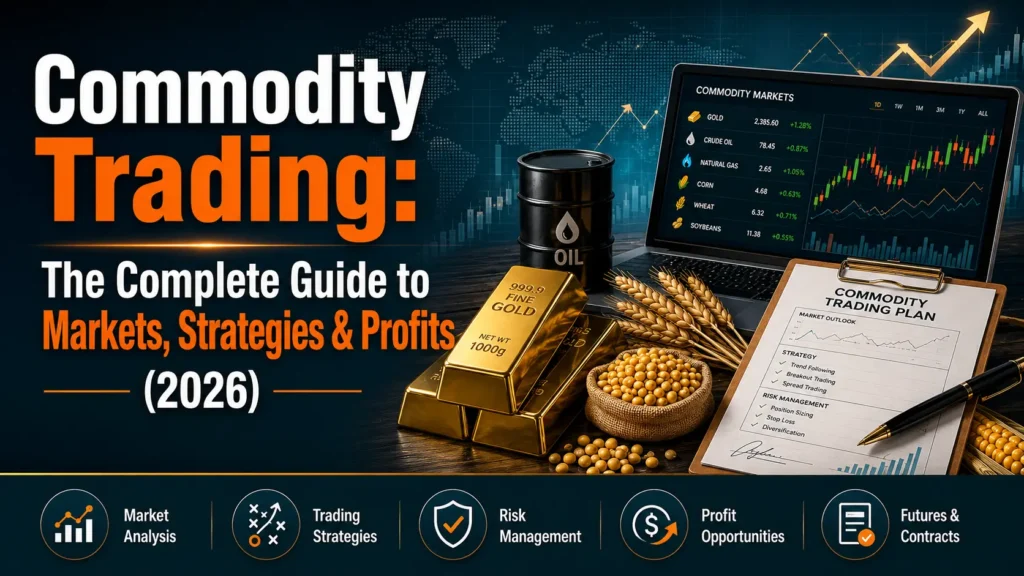
Commodity trading involves buying and selling raw materials or primary goods things like crude oil, gold, wheat, and natural gas either physically or through financial derivatives like futures and options.
Whether you’re a complete beginner looking to understand this market or an experienced trader seeking to sharpen your edge, this guide covers everything you need to know about commodity trading in 2026 strategies, risks, instruments, exchanges, and much more.
What Is Commodity Trading?
Commodity trading is the act of buying and selling standardized raw materials or agricultural products, either in the spot market (for immediate delivery) or through derivatives like futures, options, and ETFs.
Unlike stocks, which represent ownership in a company, commodities are tangible physical goods that hold intrinsic value. Their prices are driven by global supply and demand dynamics, geopolitical events, weather patterns, and macroeconomic trends.
Key Characteristics of Commodities
- Fungibility — One unit is interchangeable with another (e.g., one barrel of Brent crude = another barrel of Brent crude of the same grade)
- Standardization — Traded in uniform quantities and quality grades
- Global Demand — Essential to economies worldwide
- Price Volatility — Subject to rapid price changes due to external factors
Quick Fact: The global commodity market is valued at over $20 trillion annually, making it one of the largest financial markets in the world.
History of Commodity Markets
Commodity trading isn’t a modern invention — it’s ancient.
Around 6000 BCE, early civilizations in the Middle East traded grain and livestock using barter systems. By the 17th century, the Dutch East India Company pioneered financial derivatives to manage spice trade risk. The Chicago Board of Trade (CBOT), established in 1848, formalized futures trading and became the blueprint for modern commodity exchanges.
In India, the Bombay Cotton Trade Association (1875) was among the first organized commodity exchanges in Asia.
Today, commodity markets are electronically driven, globally interconnected, and accessible to retail traders through online platforms.
Types of Commodities Traded
Commodities are broadly classified into four categories:
1. Energy Commodities
| Commodity | Exchange | Unit |
| Crude Oil (WTI/Brent) | NYMEX / ICE | Barrels |
| Natural Gas | NYMEX | MMBtu |
| Heating Oil | NYMEX | Gallons |
| Gasoline | NYMEX | Gallons |
Energy commodities are the most actively traded due to their critical role in global industry and transportation.
2. Metals
Precious Metals:
- Gold — Safe-haven asset, inflation hedge
- Silver — Industrial + investment demand
- Platinum & Palladium — Automotive catalysts
Base Metals:
- Copper — Economic health indicator
- Aluminum, Zinc, Nickel, Lead
3. Agricultural Commodities
- Grains: Wheat, Corn, Soybeans, Rice
- Softs: Coffee, Cocoa, Sugar, Cotton
- Livestock: Live Cattle, Lean Hogs
Agricultural commodities are highly sensitive to weather, seasonal cycles, and climate policy.
4. Livestock and Meat
Less traded but significant in North American and South American markets. Includes live cattle, feeder cattle, and lean hogs.
How Commodity Trading Works
Here’s the core mechanism:
Step 1: Price Discovery Prices are set through open bidding on exchanges based on current supply, demand expectations, and macroeconomic factors.
Step 2: Contracts Traders enter contracts that specify the commodity, quantity, quality, delivery date, and price. Most retail traders never take physical delivery — they close positions before expiry.
Step 3: Settlement Contracts settle either physically (delivery of the actual commodity) or cash-settled (the difference in price is exchanged).
Example: Crude Oil Futures
Suppose crude oil is trading at ₹6,000 per barrel. You believe the price will rise due to geopolitical tensions in the Middle East. You buy 1 crude oil futures contract (100 barrels) at ₹6,000.
If the price rises to ₹6,500 and you sell:
Profit = (₹6,500 – ₹6,000) × 100 = ₹50,000
If the price falls to ₹5,500:
Loss = (₹5,500 – ₹6,000) × 100 = ₹50,000
This is why leverage and risk management are critical in commodity trading.
Major Commodity Exchanges Worldwide
| Exchange | Location | Key Commodities |
| CME Group (NYMEX/CBOT) | Chicago, USA | Oil, Gold, Grains |
| ICE (Intercontinental Exchange) | Atlanta, USA | Brent Crude, Sugar, Coffee |
| LME (London Metal Exchange) | London, UK | Base Metals |
| MCX (Multi Commodity Exchange) | Mumbai, India | Gold, Silver, Crude Oil |
| NCDEX | Mumbai, India | Agricultural Commodities |
| SHFE (Shanghai Futures Exchange) | Shanghai, China | Copper, Aluminum, Rubber |
| TOCOM | Tokyo, Japan | Gold, Rubber, Platinum |
In India, MCX is the dominant commodity exchange, accounting for over 80% of total commodity futures turnover.
Commodity Trading Instruments
There are multiple ways to gain exposure to commodity markets:
1. Futures Contracts
The most common instrument. A legal agreement to buy or sell a commodity at a predetermined price on a future date.
- High leverage (can control large positions with small capital)
- Expiry dates require active management
- Used by hedgers and speculators alike
2. Options on Futures
Give the buyer the right, but not the obligation to buy (call) or sell (put) a commodity at a specific price.
- Limited downside for buyers (premium paid)
- More complex — requires understanding of Greeks (delta, theta, vega)
3. Commodity ETFs (Exchange-Traded Funds)
- Track a basket of commodities or commodity futures
- Examples: SPDR Gold Shares (GLD), iPath Bloomberg Commodity ETF
- Ideal for long-term investors seeking commodity exposure without futures
4. Commodity Stocks
Investing in companies that produce or mine commodities — e.g., ONGC (crude oil), Hindustan Zinc, Coal India.
- Indirect commodity exposure
- Subject to corporate risk in addition to commodity price risk
5. CFDs (Contracts for Difference)
- Popular with retail traders in India and globally
- No physical delivery; profit/loss based on price movement
- Higher risk due to leverage
6. Spot Markets
Buying the physical commodity for immediate delivery. Common in gold and silver buying for investment or commercial use.
Top Commodity Trading Strategies
Experienced commodity traders rely on a combination of fundamental and technical analysis. Here are the most effective strategies:
1. Trend Following
“The trend is your friend” — one of the oldest rules in trading.
Commodity prices often trend for extended periods due to supply/demand imbalances. Traders use moving averages (MA), MACD, and ADX to identify and ride trends.
Best for: Crude oil, gold, agricultural commodities
2. Seasonal Trading
Many agricultural commodities follow predictable seasonal patterns.
- Corn prices often soften after the US harvest (September–November)
- Natural gas prices typically rise before winter
- Gold often rallies in August-September (Indian wedding season demand)
Trading seasonality requires studying 10–20 years of historical price data.
3. Spread Trading (Pair Trading)
Buying one commodity while simultaneously selling a related one.
Examples:
- Crack Spread: Crude oil vs. refined petroleum products
- Crush Spread: Soybeans vs. soybean oil + soybean meal
- Gold-Silver Ratio: Go long silver and short gold when ratio is historically high
This strategy reduces directional risk and focuses on the relative performance between two assets.
4. Fundamental Analysis–Driven Trading
This involves analyzing supply/demand data, government reports, weather forecasts, and geopolitical events.
Key reports to track:
- USDA Crop Reports (Agricultural commodities)
- EIA Petroleum Status Report (Crude oil, natural gas)
- COT Report (Commitment of Traders) — tracks positioning of large speculators vs. commercials
5. Breakout Trading
Identifying key price levels (support/resistance, consolidation zones) and entering positions when price breaks decisively above or below them.
Useful with commodities like gold and crude oil that tend to make explosive moves during breakouts.
6. Mean Reversion
The idea that commodity prices revert to a long-term average after extreme moves.
Uses indicators like RSI (below 30 = oversold), Bollinger Bands, and statistical z-scores to identify extreme deviations.
Risk Management in Commodity Trading
This is where most traders fail — not in strategy, but in managing losses.
Essential Risk Rules
1. Position Sizing Never risk more than 1–2% of your trading capital on a single trade. This protects you from catastrophic drawdowns.
2. Stop-Loss Orders Always define your exit before entering a trade. A stop-loss limits your downside.
3. Avoid Over-Leveraging Commodity futures offer high leverage. Using the maximum available leverage is a fast route to account blow-up.
4. Diversification Don’t concentrate in one commodity. Spread exposure across energy, metals, and agri to reduce correlated risk.
5. Hedging Producers and consumers use commodity futures to hedge against unfavorable price moves. For example, an airline buys crude oil futures to lock in fuel costs.
Common Mistakes to Avoid
- Trading without a clear plan
- Holding losing positions hoping for a reversal (averaging down)
- Ignoring storage/delivery considerations in futures
- Underestimating volatility during geopolitical events
- Not accounting for rollover costs in ETFs
Commodity Trading vs Stock Trading
| Feature | Commodity Trading | Stock Trading |
| Underlying Asset | Physical goods | Company shares |
| Leverage | High (5x–20x typical) | Moderate (up to 5x in India) |
| Trading Hours | Extended / near 24 hours | Fixed market hours |
| Expiry | Futures expire; physical delivery | No expiry for stocks |
| Volatility | High; driven by global events | Moderate to high |
| Dividends | None | Possible |
| Diversification | Against equity markets | Correlated with economy |
| Regulatory Body (India) | SEBI / FMC (now merged) | SEBI |
Which is better? Neither is universally superior. Commodity trading offers portfolio diversification and inflation hedging, while stocks offer ownership and dividend income. Many experienced traders participate in both.
How to Start Commodity Trading in India
Getting started with commodity trading in India is straightforward. Here’s a step-by-step roadmap:
Step 1: Choose a Broker
Select a SEBI-registered broker that offers commodity trading on MCX and NCDEX. Popular options include:
- Zerodha (Kite)
- Angel One
- ICICI Direct
- HDFC Securities
- Motilal Oswal
Step 2: Open a Commodity Trading Account
You’ll need:
- PAN card
- Aadhaar card
- Bank account details
- Address proof
- Passport-size photo
Most brokers offer online KYC — account opening takes 24–48 hours.
Step 3: Fund Your Account
Transfer funds via NEFT/RTGS/UPI. MCX requires margin deposits — typically 5–15% of the total contract value.
Step 4: Learn the Platform
Spend time on a paper trading or demo account before risking real capital. Understand order types, chart tools, and margin calculations.
Step 5: Start Small
Begin with 1 lot of a commodity you understand — gold or silver is a good starting point for Indian traders due to familiarity with the market.
Step 6: Track Market Reports
Monitor:
- MCX daily market reports
- USDA, EIA reports (if trading internationally linked commodities)
- RBI policy decisions (impact on rupee, affecting import-linked commodities)
Pros and Cons of Commodity Trading
Advantages
- Inflation Hedge — Commodities often rise with inflation, protecting purchasing power
- Portfolio Diversification — Low or negative correlation with equities during crises
- High Liquidity — Major commodities like gold and crude oil have deep, liquid markets
- Leverage — Control large positions with relatively small capital
- Transparency — Prices set by open global market forces
- 24-Hour Market — Commodity futures markets operate almost round-the-clock
- Hedging Tool — Essential for businesses managing input cost risk
Disadvantages
- High Volatility — Prices can swing dramatically on geopolitical or weather events
- Leverage Risk — Can amplify losses as much as gains
- Expiry Complexity — Futures contracts require active management and rolling
- Storage/Delivery Risk — Physical delivery obligations if positions aren’t closed
- Complex Fundamentals — Requires tracking global supply-demand, weather, geopolitics
- Margin Calls — Sudden adverse moves can trigger urgent margin calls
- Regulatory Changes — Government policy (export bans, import duties) can disrupt prices
Commodity Trading Trends in 2026
The commodity landscape is evolving rapidly. Here are the key trends shaping markets this year:
1. Energy Transition & Green Commodities
The shift to renewable energy is creating massive demand for copper, lithium, cobalt, and nickel — critical minerals for EV batteries and solar panels. Copper, often called “Dr. Copper” for its predictive power over economic health, is expected to face supply deficits through the late 2020s.
2. Geopolitical Fragmentation
US-China trade tensions, Russia-Ukraine conflict aftermath, and Middle East instability continue to disrupt supply chains for oil, natural gas, grains, and metals. Commodity traders in 2026 must factor in geopolitical risk premiums more than ever.
3. AI and Algorithmic Trading
Quantitative hedge funds and algorithmic traders now dominate commodity futures markets. Retail traders increasingly use AI-based tools for sentiment analysis, satellite imagery of crops and oil storage, and real-time weather data integration.
4. Climate Volatility & Agricultural Markets
Erratic weather patterns due to climate change are making agricultural commodity prices more volatile. El Niño/La Niña cycles now have outsized influence on cocoa (Ghana/Ivory Coast), coffee (Brazil), and wheat (Australia, Ukraine).
5. Commodity Supercycle Discussion
Many analysts debate whether we are in a commodity supercycle — a prolonged period of rising prices driven by infrastructure buildout, urbanization in emerging markets, and under-investment in new supply. Whether or not this materializes, the structural demand story for metals remains strong.
6. India’s Growing Role
India’s commodity derivatives market is maturing. SEBI’s regulatory reforms, increased institutional participation, and growing retail trader awareness are expanding MCX volumes. India’s rising gold imports and energy demand make it an increasingly influential price-setter.
Conclusion
Commodity trading is a powerful financial tool — one that has shaped economies, funded wars, fueled industrial revolutions, and made fortunes for those who understood its mechanics.
In 2026, commodity trading remains as relevant as ever. From gold’s enduring role as a wealth preserver to copper’s strategic importance in the clean energy transition, raw materials continue to be the backbone of the global economy.
But this market demands respect. The same leverage and volatility that create opportunity also destroy underprepared traders.
Your path to success in commodity trading starts with education, continues with practice (demo accounts), and grows through disciplined risk management. Start small, learn consistently, and always trade with capital you can afford to lose as you build experience.
The markets will always be there. Make sure you are too.
Call to Action (CTA)
Ready to Start Commodity Trading?
Open a commodity trading account with a registered broker today
Practice on a paper trading platform for 30 days before risking real capital
Subscribe to MCX daily reports and stay updated on global commodity news
Bookmark this guide and revisit each section as you gain experience
Have questions about commodity trading? Drop them in the comments below and Connect with Us On Comex Alert
FAQ
Commodity trading can be profitable, but it carries significant risk. Success depends on strategy, discipline, risk management, and market knowledge. Studies suggest that a majority of retail futures traders lose money, making education and practice essential before trading with real capital.
Spot trading means buying/selling the commodity for immediate delivery at the current market price. Futures trading involves a contract to buy or sell at a set price on a future date. Most traders use futures for speculation without ever taking physical delivery.
Commodity prices are influenced by supply and demand fundamentals, geopolitical events, currency movements (especially USD), weather and climate, government policies (tariffs, export bans), inflation, interest rates, and speculative positioning by large traders
Hedging is a risk management strategy where a business or investor takes an opposite position in the futures market to protect against unfavorable price movements. For example, a wheat farmer sells wheat futures to lock in a price, protecting against a fall in market prices before harvest.