






Gold prices can rise sharply one day and fall just as fast the next. For traders, these moves can create opportunities, but they also bring risk. Without a clear plan, it is easy to enter a trade too early or hold a losing position for too long.
A gold trading strategy helps traders make better-planned decisions. It sets clear rules for when to buy, when to sell, and how to manage risk. Smart traders do not try to predict every price move. They study market trends, wait for suitable conditions, and follow their trading plans.
Gold traders also need to understand market timing. For example, price activity may change during different gold trading hours, especially when European and US markets are active.
So, what do smart gold traders do differently? Let’s look at the methods they use to analyse gold and manage their trades
What Is a Gold Trading Strategy?
A gold trading strategy is a planned method for trading gold based on price movements, market conditions, and risk limits.
Traders use these rules to decide when to enter and exit the market. They may study price charts, economic news, and technical indicators before making a decision.
Gold can be traded through different products, including:
-
- Spot Gold (XAUUSD): The market price of gold quoted in US dollars.
-
- COMEX Gold Futures: Exchange-traded contracts linked to gold prices and specific contract terms.
-
- Gold CFDs: Products that allow traders to speculate on price changes without owning physical gold.
These products are related, but their trading costs, contract terms, and risks are different.
The CME Group’s gold futures information explains how exchange-traded gold contracts work.
A good strategy should match the product being traded, the trader’s experience, and the amount of risk they can accept.
Why Do Smart Traders Follow a Gold Trading Strategy?
Gold prices respond to many events. A change in interest rates, a strong US dollar, or unexpected global news can affect market sentiment.
Smart traders understand that they cannot control these events. Instead, they prepare for different outcomes.
A clear trading strategy helps traders:
-
- Identify possible market trends.
-
- Choose suitable entry and exit points.
-
- Avoid emotional trading decisions.
-
- Set stop-loss and take-profit levels.
-
- Manage exposure during volatile markets.
The World Gold Council identifies interest rates, currencies, investment demand, and market risks among the key factors that influence gold.
This is why traders often combine chart analysis with economic information rather than relying on price movements alone.
Best 5 Gold Trading Strategies Smart Traders Use
There is no single best gold trading strategy for every market condition.
Some methods work better during strong trends. Others focus on short-term price moves or sideways markets.
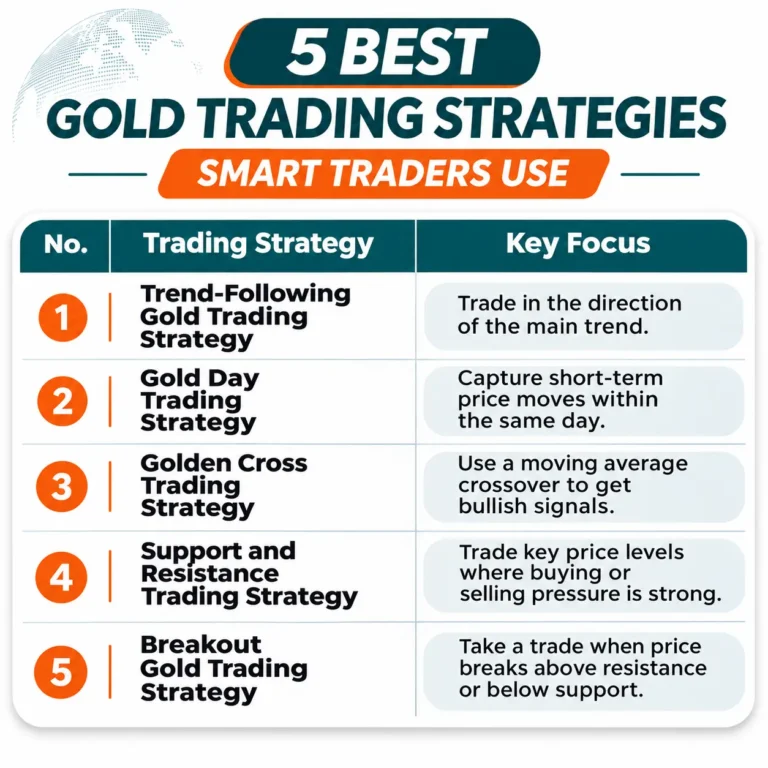
Here are five common approaches.
1. Trend-Following Gold Trading Strategy
Trend following means trading in the direction of the main price movement.
When gold forms higher highs and higher lows, it may indicate an upward trend. Lower highs and lower lows may suggest a downward trend.
A trader may use moving averages to confirm the general direction.
For example, if gold stays above a rising moving average, a trader may wait for a small price pullback before considering a buy position.
However, trends can change without warning. A stop-loss remains important because a pullback may turn into a reversal.
2. Gold Day Trading Strategy
A gold day trading strategy focuses on opening and closing positions within the same trading day.
Day traders study short-term price changes rather than holding trades for several days.
They often watch:
- Intraday support and resistance levels.
- Price movements during active market sessions.
- Trading volume and momentum.
- Major economic announcements.
For example, a trader may notice gold moving within a narrow range during the morning. If the price breaks above resistance later in the day, they may examine whether the move has enough strength to continue.
Day trading requires attention and discipline. Frequent trading can also increase costs.
3. Golden Cross Trading Strategy
The golden cross trading strategy uses moving averages to identify a possible shift toward an upward trend.
A golden cross occurs when a shorter-term moving average crosses above a longer-term moving average.
This may suggest that recent buying strength is improving.
Traders often look for confirmation from price action and trading volume before acting.
For example, gold may begin recovering after a period of decline. If the shorter moving average crosses above the longer one, traders may interpret it as a bullish signal.
But there is an important limitation.
Moving averages use past prices. This means a golden cross can appear after much of the price recovery has already happened.
It can also produce misleading signals when gold moves sideways.
4. Support and Resistance Trading Strategy
Support and resistance are price areas where buying or selling pressure has appeared before.
Support is an area where falling prices may attract buyers. Resistance is an area where rising prices may face selling pressure.
Traders use these levels to plan possible entries and exits.
Imagine gold approaches a price level where buyers have stepped in several times.
A trader may watch for a clear sign of buying interest before considering a position.
However, support can break, and resistance can turn into support. These levels are areas of interest, not guaranteed turning points.
The same principle appears in broader commodity trading strategies, where price structure helps traders assess market conditions.
5. Breakout Gold Trading Strategy
A breakout happens when gold moves beyond an established support or resistance level.
Traders watch breakouts because they may signal a change in market direction or momentum.
For example, gold may trade within a narrow range for several hours. A strong move above the range could suggest growing buying interest.
Some traders wait for the price to return to the broken level before deciding whether to enter.
This is called a retest.
The main risk is a false breakout. Gold may briefly cross a price level and then move back into its earlier range.
Waiting for confirmation may reduce impulsive entries, but it cannot remove the risk of a failed trade.
What Makes a Gold Trading Strategy Work Better?
A strategy is more useful when it matches current market conditions.
Smart traders usually check several factors before opening a position.
Understand the Market Trend
Start with the broader price direction.
A market moving steadily upward may call for a different approach from one moving sideways.
Check the higher-timeframe chart before focusing on smaller price movements.
This can help prevent trades that go against a strong market trend.
Watch Economic News
Gold can react strongly to US inflation reports, Federal Reserve decisions, and changes in the dollar.
These events may cause rapid price changes and wider spreads.
Traders should know when important announcements are scheduled and decide whether trading during those periods fits their risk tolerance.
Choose the Right Trading Session
Gold trading activity changes throughout the day.
For traders in the UK, Germany, and France, the London session is an important period to monitor.
Traders in Dubai, Saudi Arabia, and other Gulf markets may also follow the London session and the opening of US trading activity.
New York market hours are especially relevant when major US economic reports are released.
Session times can shift because of daylight-saving changes. Traders should always check the correct local time and their broker’s trading schedule.
Gold Trading Strategy for Beginners: How to Plan a Trade
Gold Trading for Beginners should start with a simple plan, not a collection of complicated indicators.
Before entering any trade, follow these steps.
Step 1: Identify the trend. Check whether gold is rising, falling, or moving sideways.
Step 2: Mark important price levels. Find areas where the price has reacted before.
Step 3: Wait for a setup. Look for a breakout, pullback, or another pattern that matches your strategy.
Step 4: Set your stop-loss. Decide where the trade idea becomes invalid.
Step 5: Choose your position size. Make sure the possible loss fits your risk limit.
Step 6: Review the result. Record what happened and whether you followed your plan.
Keeping a trading journal can help you recognise repeated mistakes.
At COMEX Alert, market analysis is also presented through gold and XAUUSD trading signals with defined entry, target, and stop-loss levels. However, every setup still needs independent review.
How Do Smart Traders Manage Gold Trading Risk?
Risk management is one of the most important parts of any trading strategy.
Gold can move quickly, especially when unexpected news changes market expectations.
Leverage can increase exposure to these movements. This means even a small price change may lead to a large gain or loss relative to the margin used.
Smart traders plan for losses before entering the market.
They consider trading costs, position size, stop-loss placement, and the possibility of price gaps or slippage.
A stop-loss helps define an intended exit, but execution at the exact price is not always guaranteed.
The US Commodity Futures Trading Commission explains the risks involved in futures trading and why traders should understand contracts before participating.
Some traders also use automated systems to follow preset rules. However, even an automated Gold EA can produce losses when market conditions change.
The main goal is to make risk manageable rather than assume every trade will succeed.
Common Gold Trading Mistakes to Avoid
Even an experienced trader can make mistakes when the market becomes unpredictable.
Common problems include:
- Trading without a plan: Entering positions because prices suddenly move.
- Ignoring market news: Opening trades without checking upcoming announcements.
- Using excessive leverage: Taking positions that are too large for the account.
- Moving stop-loss levels: Increasing potential losses to avoid closing a trade.
- Overtrading: Taking unnecessary positions after wins or losses.
A good strategy also includes knowing when not to trade.
If the market is unclear or the risk is too high, waiting may be the better decision.
Conclusion: Trade Gold With a Plan, Not a Guess
A successful gold trading strategy is not about predicting every market move. It is about understanding price behaviour, following clear rules, and managing uncertainty.
Smart traders study trends, identify important price levels, watch market news, and define their risks before placing a trade.
They also understand that different market conditions may require different approaches.
The gold market analysis and XAUUSD trading information available through COMEX Alert can form part of a trader’s wider research process.
Whether you prefer day trading, trend following, or the golden cross method, start with a strategy you understand. Test it carefully, keep your risk under control, and avoid decisions driven by fear or excitement.
Risk Disclaimer: This article is for educational purposes only and does not provide personalised financial advice. Gold futures, CFDs, and leveraged trading involve substantial risk. Losses may exceed the amount initially deposited, depending on the product and account terms.
Frequently Asked Questions...
Trend following and support-and-resistance trading are relatively simple methods to study. Beginners should practise with historical charts or a demo account before risking real money.
A golden cross can help identify a possible bullish trend. However, it is a lagging indicator and may produce false signals. Traders should consider price action and broader market conditions.
Day trading involves opening and closing positions within the same day. Swing trading involves holding positions over longer periods to follow broader price movements.
Some technical methods apply to both markets. However, COMEX futures and spot gold products have different contract terms, trading costs, and risk requirements. Traders should adjust their plans accordingly.
No. Every strategy can produce losing trades. Market volatility, leverage, unexpected news, and execution costs can affect results.