



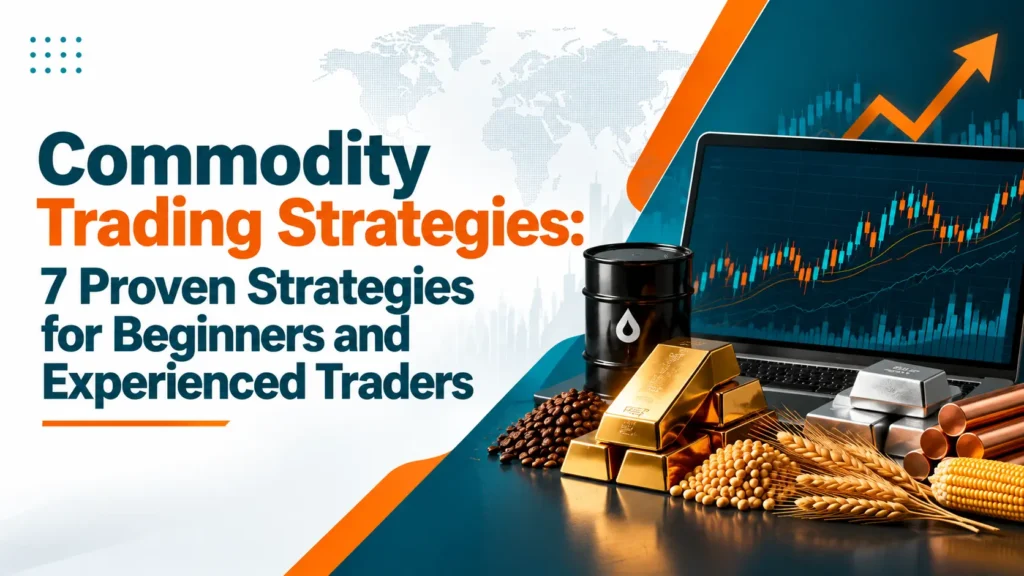
Commodity trading strategies give traders a clear way to approach markets such as gold, crude oil, natural gas, copper, and agricultural products. Commodity prices can move fast because of changes in supply, demand, weather, inventories, interest rates, and global events.
There is no strategy that works in every market. A method that works well in a strong trend may fail when prices move sideways. The key is to understand how each strategy works and when to use it. In this guide, we explain seven popular commodity strategies, simple examples, and practical risk management tips for both new and experienced traders.
What Are Commodity Trading Strategies?
Commodity trading strategies are planned methods used to find trading opportunities and manage risk. They help traders decide when to enter, when to exit, and when to stay out of the market.
Common approaches include trend following, breakout trading, mean reversion, fundamental analysis, seasonal trading, spread trading, and hedging.
Before trading futures, it is important to understand contract size, margin, expiration dates, and leverage. Futures trading can lead to large losses.
What Are the 7 Best Commodity Trading Strategies?
1. Trend-Following Strategy
Trend following is one of the simplest commodity strategies to understand. The goal is to trade in the same direction as the market trend.
For example, suppose gold keeps making higher highs and higher lows. A trader may look for a pullback before entering a long position.
Traders often use moving averages, support and resistance, and price action to identify trends.
The main risk is a sudden trend reversal. A clear exit plan is important before entering the trade.
2. Breakout Trading Strategy
A breakout happens when price moves above resistance or below support.
This strategy is useful when a commodity has stayed inside a narrow price range for some time. A strong move outside that range may signal increased buying or selling pressure.
For example, a crude oil trader may watch a key resistance level. If price breaks above it with strong momentum, the trader may consider a long setup.
False breakouts can happen, so traders should avoid entering based on one price move alone.
3. Mean Reversion Strategy
Mean reversion is based on the idea that prices may move back toward a recent average after a sharp move.
This strategy can work better in range-bound markets. Traders may use moving averages, Bollinger Bands, or support and resistance to spot stretched prices.
For example, if a commodity falls sharply while the broader market remains in a stable range, a trader may look for signs of a rebound.
However, a market can remain overbought or oversold for a long time. A low price does not always mean a commodity is ready to rise.
4. Fundamental Trading Strategy
Fundamental analysis looks at the real-world factors that affect commodity prices.
These can include:
- Supply and demand
- Inventory levels
- Weather conditions
- Production
- Economic growth
- Interest rates
- Geopolitical events
For example, weather can affect agricultural commodities, while oil prices can react to changes in supply, storage, and demand.
This approach can help traders understand why prices are moving rather than looking only at a chart.
5. Seasonal Trading Strategy
Some commodities show seasonal patterns because production and demand can change during the year.
Agricultural commodities are a common example. Planting, growing, and harvest cycles can affect supply at different times of the year.
A trader may study past seasonal patterns and compare them with current market conditions.
Seasonality should not be used alone. Weather, inventories, policy changes, and unexpected events can change the usual pattern.
6. Spread Trading Strategy
Spread trading involves taking positions in two related contracts or markets.
Instead of relying only on whether a commodity will rise or fall, the trader focuses on the price difference between two related positions.
For example, traders may compare different delivery months of the same futures contract.
Spread trading can be useful for more advanced traders. However, it still carries risks such as liquidity risk, market risk, and changes in the relationship between the contracts.
7. Hedging and Risk Management
Hedging is different from a typical speculative trade. It is mainly used to reduce the effect of unwanted price changes.
For example, a business that depends on a commodity may use futures to help manage future price risk. CME Group explains that hedgers use futures to offset exposure to price changes.
For individual traders, risk management should be part of every commodity market strategy.
Simple rules can include:
- Use an appropriate position size.
- Set a clear stop-loss or exit level.
- Understand margin requirements.
- Avoid risking money needed for daily expenses.
- Keep a record of your trades.
The CFTC warns that futures trading can be highly volatile and may result in substantial losses.
Which Commodity Market Strategy Is Best for Beginners?
There is no single best commodity market strategy for everyone.
For beginners, trend following and breakout trading can be easier to understand because the rules are relatively clear. New traders should first learn how futures contracts work, including leverage, margin, expiration, and contract value.
You can also read our guides on commodity trading and how to invest in commodities before choosing a strategy.
How Do Experienced Traders Choose Commodity Strategies?
Experienced traders usually adjust their strategy based on market conditions.
A strong trend may favor trend following. A sideways market may suit mean reversion. Fundamental analysis can provide market context, while technical analysis can help with entry and exit timing.
Before choosing a strategy, consider the commodity, timeframe, volatility, trading costs, and your risk tolerance.
For more market insights, see our guide to commodity trader strategies and market moves.
Final Thoughts
The best commodity trading strategies are not always the most complex ones. A simple strategy with clear rules can be easier to test and follow.
Trend following, breakouts, mean reversion, fundamentals, seasonality, spreads, and hedging each have a different purpose. The right approach depends on the market and your trading style.
Before placing a trade, understand the market, define your risk, and have a clear reason for entering and exiting. You can also explore our latest US commodity market coverage for additional market context.
Financial Disclaimer: This article is for educational purposes only and is not financial or investment advice. Commodity and futures trading involves significant risk. Leverage can increase both gains and losses, and past performance does not guarantee future results.
Frequently Asked Questions
There is no universal best strategy. Trend following, breakouts, mean reversion, fundamental analysis, and seasonal trading can all work in different market conditions. The right choice depends on the commodity, timeframe, risk level, and trading goals. Traders should test a strategy before using real money.
Yes, but beginners should start with simple strategies and learn the basics first. It is important to understand futures contracts, leverage, margin, and expiration. Start with a clear trading plan and avoid risking money that you cannot afford to lose.
Risk management is one of the most important parts of commodity trading. Price swings can be large, especially in leveraged futures markets. Position sizing, exit rules, and margin awareness can help reduce unnecessary risk. The CFTC also warns that futures trading can lead to substantial losses.
Yes. Many traders combine different methods. For example, fundamental analysis can show the broader market direction, while technical analysis can help find an entry point. Combining strategies can improve market analysis, but it does not remove trading risk.
Commonly traded commodities include gold, silver, crude oil, natural gas, copper, and agricultural products such as wheat, corn, and soybeans. The exact products available depend on the market and exchange. Each commodity also has its own supply, demand, volatility, and trading characteristics.
Commodity trading can produce profits, but there is no guaranteed return. Prices can move quickly, and leverage can increase both gains and losses. A sound strategy, careful position sizing, and disciplined risk management are more important than trying to predict every market move.